Chapitre 16 · Grammaire
there is / there are, la maison et les prépositions
There’s a sofa next to the window : décrire une pièce, situer les objets, dire ce qu’il y a.
Le cours
À quoi ça sert ?
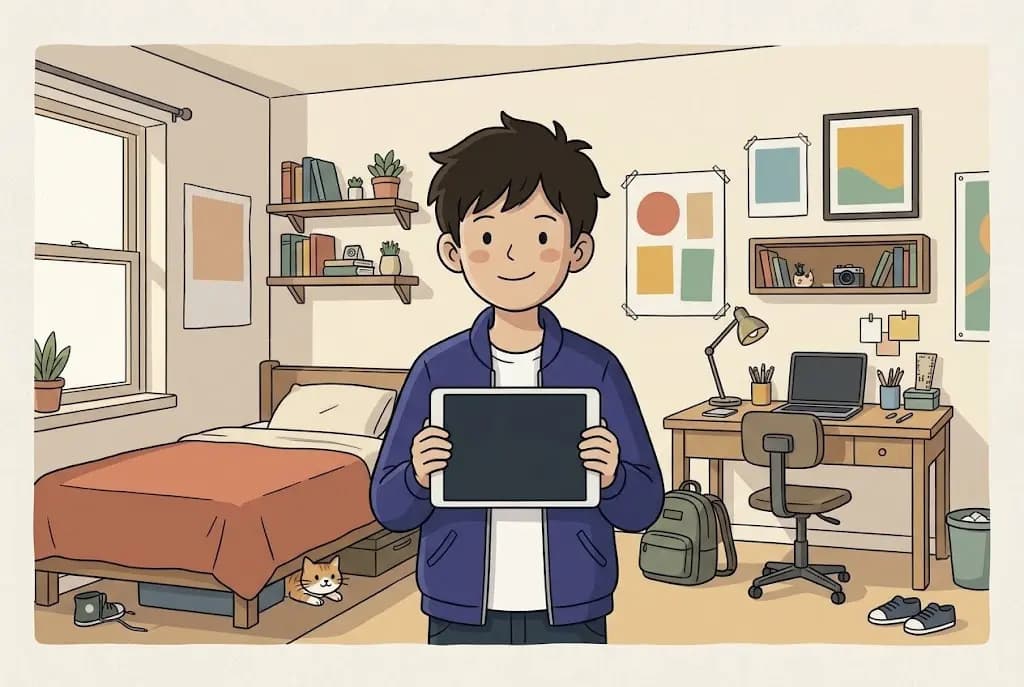
La chambre de ton correspondant
Appel vidéo avec Harry, ton correspondant de Manchester. Il te fait visiter sa maison : « There’s a big bed next to the window, and there are posters on the wall. My cat is under the bed! » Puis il te demande : « Is there a garden at your house? »
Pour décrire ta chambre, retrouver tes clés (« Where are my keys? — On the table, behind the lamp. ») ou suivre une description dans un jeu vidéo, il te faut deux outils : there is / there are (il y a) et les prépositions de lieu.
À retenir
there is / there are = il y a
| Singulier / indénombrable | Pluriel | |
|---|---|---|
| affirmatif | There’s a lamp. | There are some books. |
| négatif | There isn’t a TV. | There aren’t any chairs. |
| question | Is there a garden? | Are there any cushions? |
| réponse courte | Yes, there is. / No, there isn’t. | Yes, there are. / No, there aren’t. |
On choisit is ou are selon ce qui suit : there is a bed, there are two beds. Avec un indénombrable : there is some milk. Comme toujours : some à l’affirmatif, any au négatif et en question.
Les pièces : kitchen (cuisine), living room (salon), bedroom (chambre), bathroom (salle de bains), toilet, garden, garage, upstairs / downstairs (à l’étage / en bas). Les meubles : bed, desk, chair, wardrobe (armoire), shelf (étagère, pluriel shelves), sofa, armchair, fridge, cooker, bath, shower, mirror, rug (tapis).
À retenir
Les prépositions de lieu
| Sens | Préposition | Exemple |
|---|---|---|
| dans | in | in the box |
| sur | on | on the desk |
| sous | under | under the bed |
| à côté de | next to | next to the door |
| derrière | behind | behind the sofa |
| devant | in front of | in front of the TV |
| entre | between | between the bed and the desk |
| en face de | opposite | opposite the window |
| près de | near | near the station |
Pour demander où est un objet : « Where is (where’s) the remote? » ; plusieurs objets : « Where are my trainers? — They’re under the bed. »
Exemple
Une description complète
« In my bedroom, there’s a bed opposite the door. There are two shelves above my desk. There isn’t a TV, but there’s a computer between the lamp and the window. » → there’s (un lit), there are (deux étagères), there isn’t (pas de télé).
À retenir
Les pièges
- « il y a » ne se traduit jamais par « it has » ou « he has » : « There’s a cat », pas « It has a cat ».
- there are (il y a), they are / they’re (ils sont), their (leur) : trois sens différents, mais there, they’re et their se prononcent pareil. « There are two boys. They’re in their bedroom. »
- « in front of » = devant (pas « in face of ») ; « opposite » = en face de (de l’autre côté).
- next to, in front of : n’oublie pas le petit mot. Mais on dit « near the park » et « opposite the school », sans to ni of.
- on the wall (au mur), on the first floor, in the kitchen, in bed : la préposition anglaise ne suit pas toujours le français.
- À l’écrit, there is se contracte (there’s) mais pas there are. Et pas de contraction dans la réponse courte affirmative : « Yes, there is », jamais « Yes, there’s ».
Attention
Regarde à droite. Pour choisir is ou are, regarde le premier nom après there : « There is a sofa and two chairs » (on accorde avec « a sofa ») ; « There are two chairs and a sofa ». À l’oral, c’est ce qu’on entend chez les anglophones.
Attention
Rappel du CM. Tu connais « in, on, under » et « Where is…? ». Associe chaque préposition à un geste : la main dans la trousse (in), posée dessus (on), dessous (under). Puis ajoute les nouvelles : behind, between, opposite.
Les exercices
Niveau 1 · Découverte
Les bases, pas à pas.Niveau 2 · Entraînement
Les pièges classiques.Niveau 3 · Expert
Pour aller plus loin.