Chapitre 19 · Communiquer
En ville : impératif et itinéraires
Les lieux de la ville, l’impératif et les prépositions pour demander et indiquer son chemin.
Le cours
À quoi ça sert ?
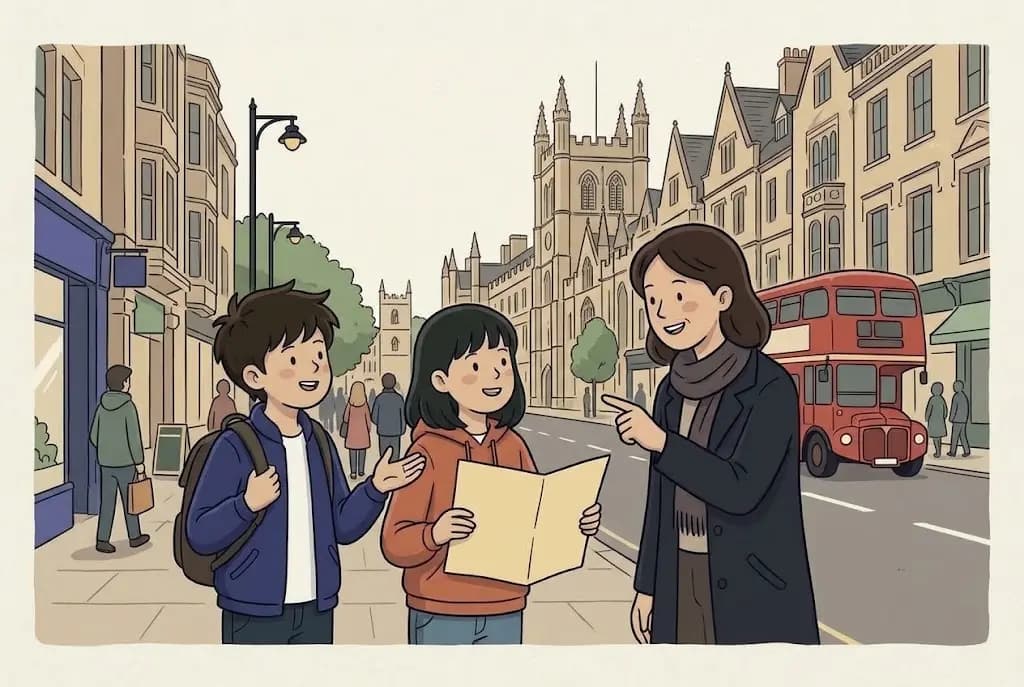
Perdu à Oxford
Voyage scolaire à Oxford : ton groupe a rendez-vous au musée à 14 h, et ton téléphone n’a plus de batterie. Tu arrêtes une passante : « Excuse me, how can I get to the museum? » Elle répond : « Go straight on, then take the second street on the left. It’s opposite the library. »
Pour comprendre cette réponse et ne pas te perdre, il te faut trois outils : les lieux de la ville, l’impératif (les ordres et consignes) et les prépositions de lieu.
À retenir
Les lieux de la ville
| Anglais | Français |
|---|---|
| the station | la gare |
| the post office | la poste |
| the library | la bibliothèque (pas la librairie !) |
| the museum | le musée |
| the chemist’s | la pharmacie |
| the bakery | la boulangerie |
| the cinema | le cinéma |
| the park | le parc |
| the hospital | l’hôpital |
| the bus stop | l’arrêt de bus |
| the bookshop | la librairie |
| the town hall | la mairie |
À retenir
L’impératif : donner une consigne
- On prend la base verbale, sans sujet : Go straight on. (allez tout droit) ; Turn left. (tournez à gauche) ; Turn right. ; Cross the road. (traversez la rue) ; Take the second street on the left.
- Négatif : Don’t + base verbale : « Don’t cross here! » (ne traverse pas ici).
- Pour proposer à ses amis : Let’s + base verbale : « Let’s take the bus! » (prenons le bus).
- La même forme sert pour tu et vous : l’anglais ne fait pas la différence.
À retenir
Demander son chemin poliment
- On commence toujours par Excuse me (excusez-moi) pour attirer l’attention.
- How can I get to the station? (comment aller à la gare ?)
- Is there a chemist’s near here? (y a-t-il une pharmacie près d’ici ?)
- Where is the bus stop, please?
- Et on termine par Thank you very much!
À retenir
Situer un lieu
- next to : à côté de — « The bakery is next to the bank. »
- opposite : en face de — « The cinema is opposite the park. »
- between : entre — « The café is between the bank and the bakery. »
- at the corner of : au coin de — « The post office is at the corner of High Street and Park Road. »
- on the left / on the right : sur la gauche / sur la droite — « It’s on your left. »
Exemple
Lire un plan en texte
« You are at the station. Go straight on along King Street. Turn right at the traffic lights. The library is the second building on your left, next to the bakery. » → tout droit, à droite aux feux, deuxième bâtiment à gauche, à côté de la boulangerie. Trace l’itinéraire avec ton doigt sur un plan : c’est l’exercice classique des examens.
À retenir
Les pièges
- library = bibliothèque ; la librairie se dit bookshop. Un faux ami classique.
- Pas de sujet à l’impératif : « You turn left » est une phrase affirmative, la consigne est « Turn left ».
- La négation se fait avec don’t, jamais avec not seul : « Not cross » → Don’t cross.
- opposite ne prend pas de « of » : « opposite the park », pas « opposite of the park ». Mais next to garde son « to ».
- Turn left (tourne à gauche : un mouvement) n’est pas on the left (sur la gauche : une position). Et tout droit se dit straight on, pas « all right ».
Attention
Look right! Au Royaume-Uni, on roule à gauche. Les voitures arrivent donc d’abord par la droite quand tu traverses : c’est pourquoi on lit « Look right » peint sur le sol des passages piétons à Londres. Un réflexe qui peut te sauver la vie pendant un voyage scolaire.
Attention
Méthode pour un itinéraire. Repère d’abord le point de départ, puis souligne chaque verbe à l’impératif (go, turn, take, cross) : chacun est une étape. Les prépositions (next to, opposite) servent à la fin pour reconnaître le bâtiment.
Les exercices
Niveau 1 · Découverte
Les bases, pas à pas.Niveau 2 · Entraînement
Les pièges classiques.Niveau 3 · Expert
Pour aller plus loin.